


Infinity Stonepaper
Pens, Cleaning,
Mounting,
Material.
Three simple moves decide how easy it is to work with: the right pen, the way back to an empty surface and the options for mounting. Here you find what has proven itself in practice, what the material is made of and what it can take.
Two thirds
limestone
Finely ground stone. HDPE holds the rest together, a plastic.
450 g/m²,
0.3 millimetres
An A4 sheet weighs around 28 grams and sits solidly in your hand.
Waterproof
and tear-resistant
Roll it, bend it, let it get wet: the surface stays as it is.
Cradle to Cradle
Certified
Verified by an independent body, for the material itself.
Material and handling, 1 of 3
Which pens,
for what.
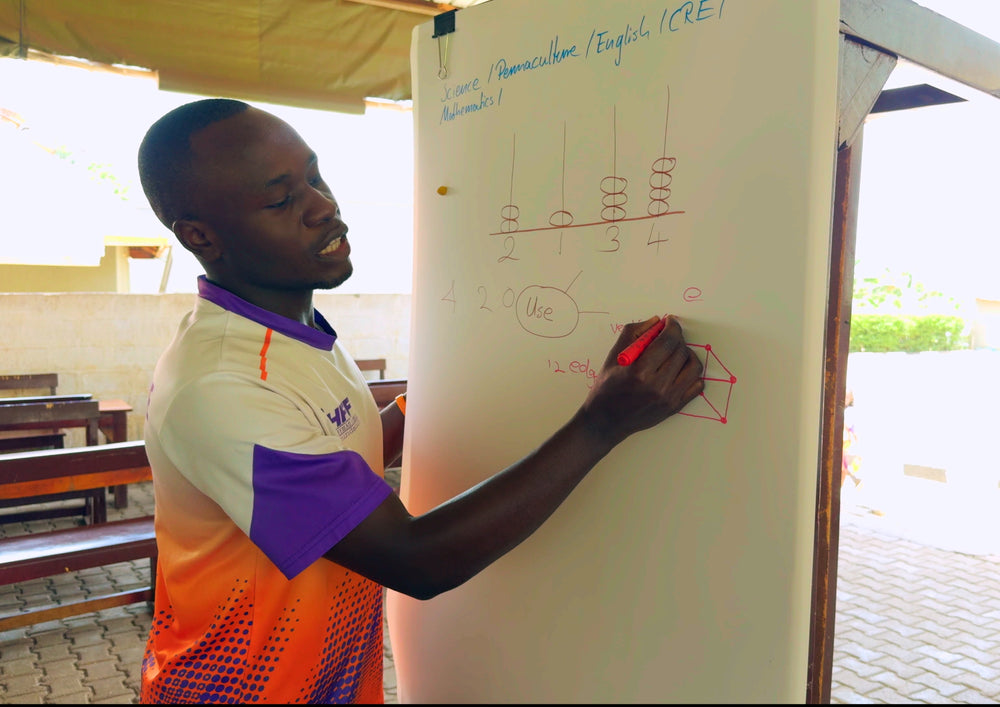
We recommend water-based felt pens and thermosensitive erasable pens. The first kind glows brightly and can be read across the room, the second writes finely and comes off again with a touch of moisture. Whiteboard markers and permanent pens stay put, and sometimes that is exactly the point.
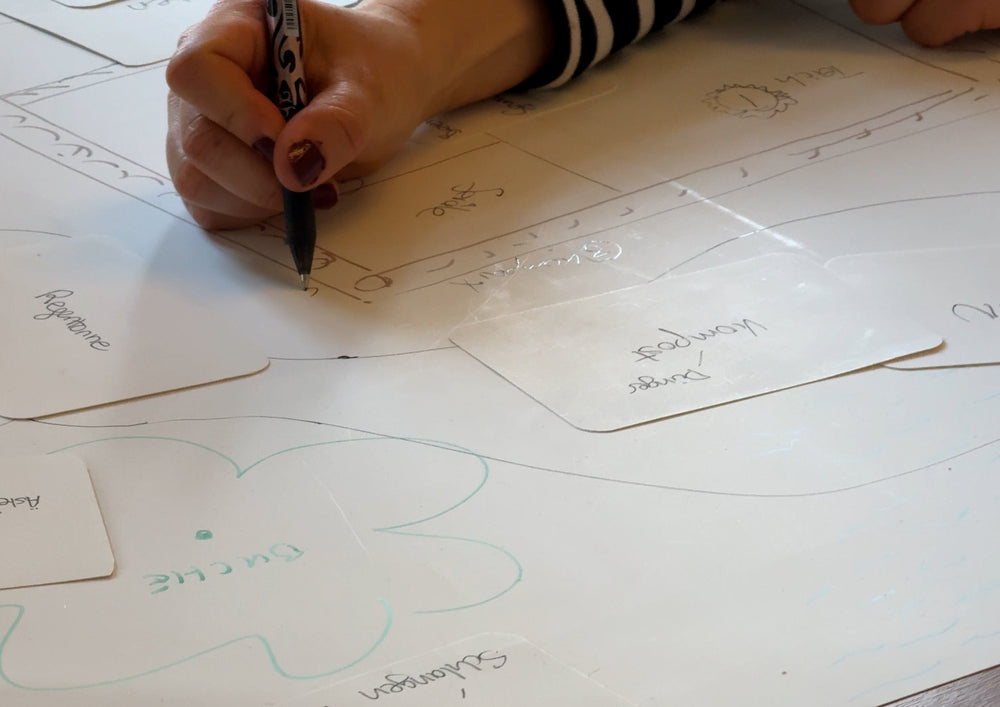
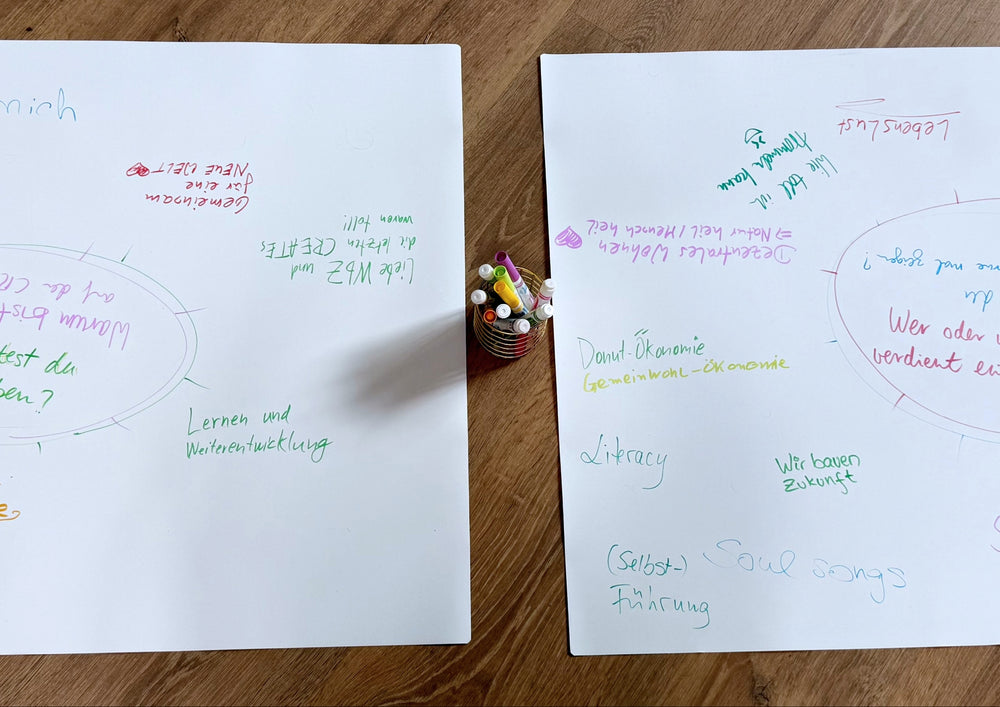
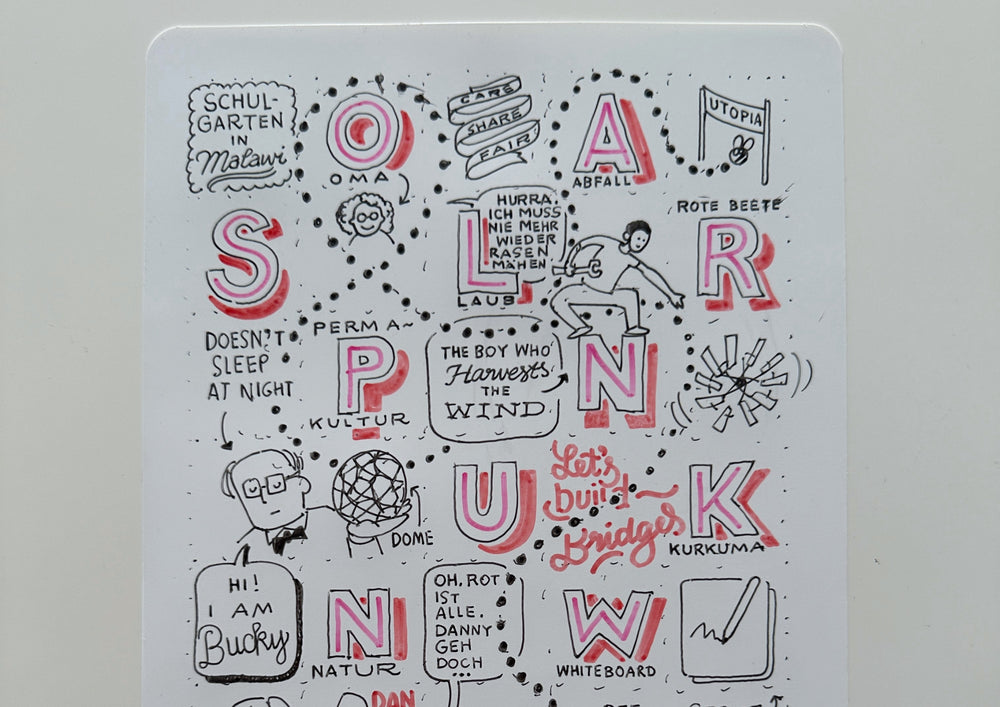
Thermosensitive ink dissolves with very little water. For everything that changes daily, this is the easiest way back to an empty surface. Worth knowing: from around 60 degrees this ink fades on its own, and the freezer brings it back. So a board in bright sunshine is clear again by the evening.
The Frixion ballpoint writes finely, for plans with many details. The felt-tip pen carries overviews and mind maps. Both glide across the smooth surface almost by themselves, which makes long writing easy.
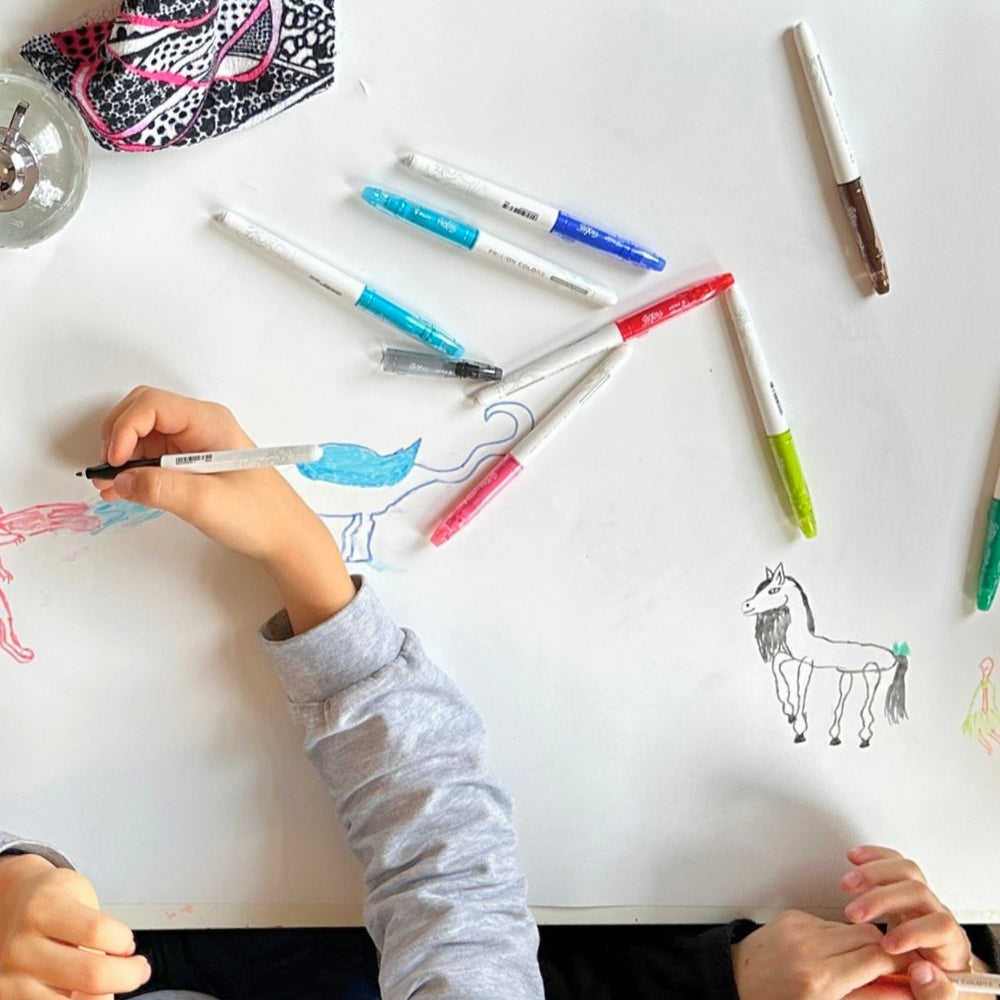
Ultra-washable children's felt-tip pens are strong in colour, legible from a distance and wash off completely. Our first choice for Boards and XXL, within reach in a tin or a cup, so that every hand can pick one up straight away.
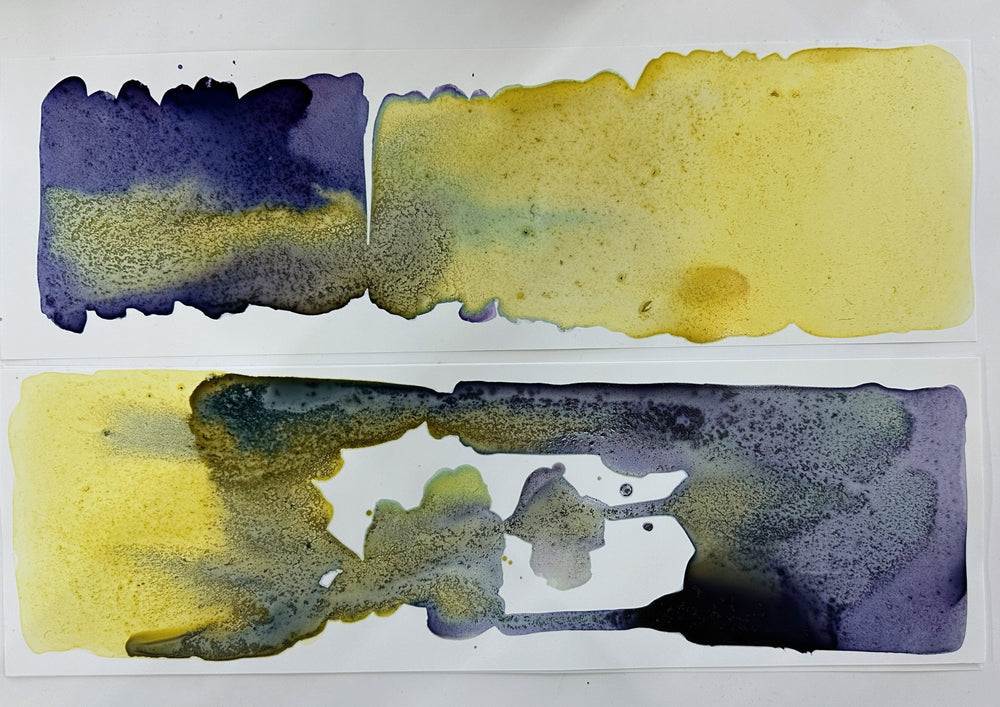
Colours from hibiscus, marigold or safflower sit on top just like felt-tip pen and come off just as well. In the sevengardens network you learn how to make them yourself.
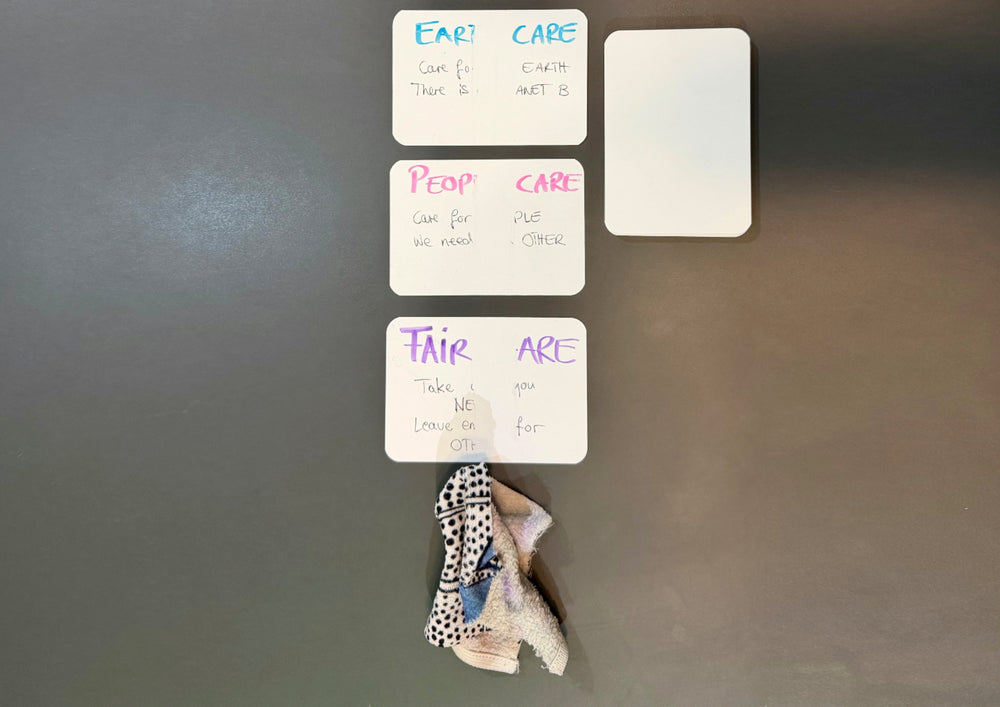
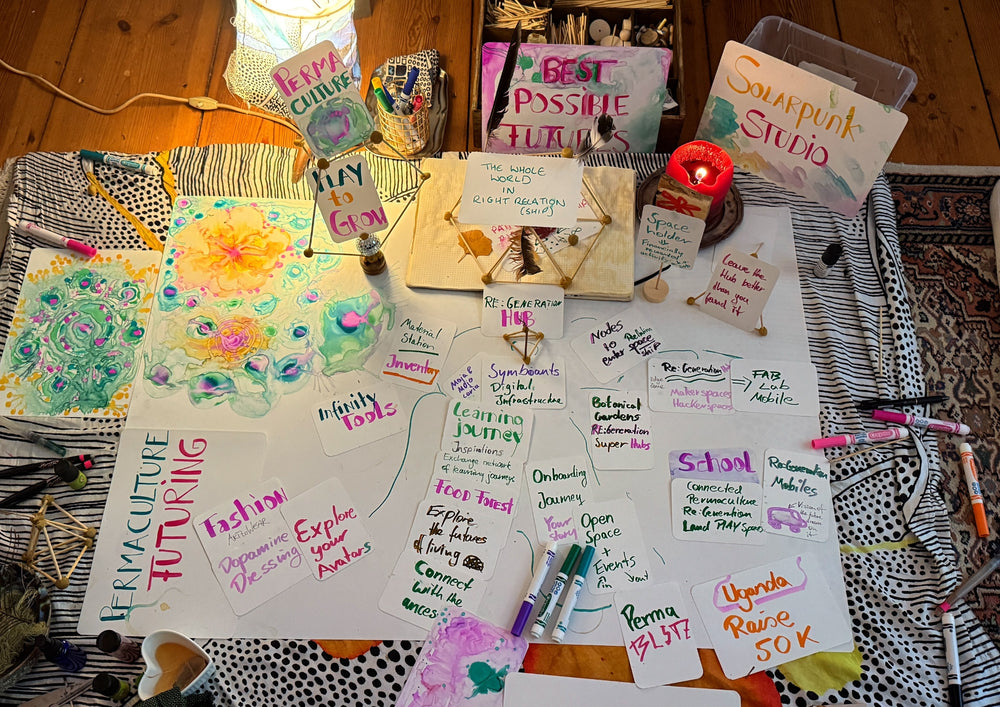
Cards, pens and colours together: the project display gains a design quality that goes beyond bullet points. If you also paint the topic, you see it from another side.
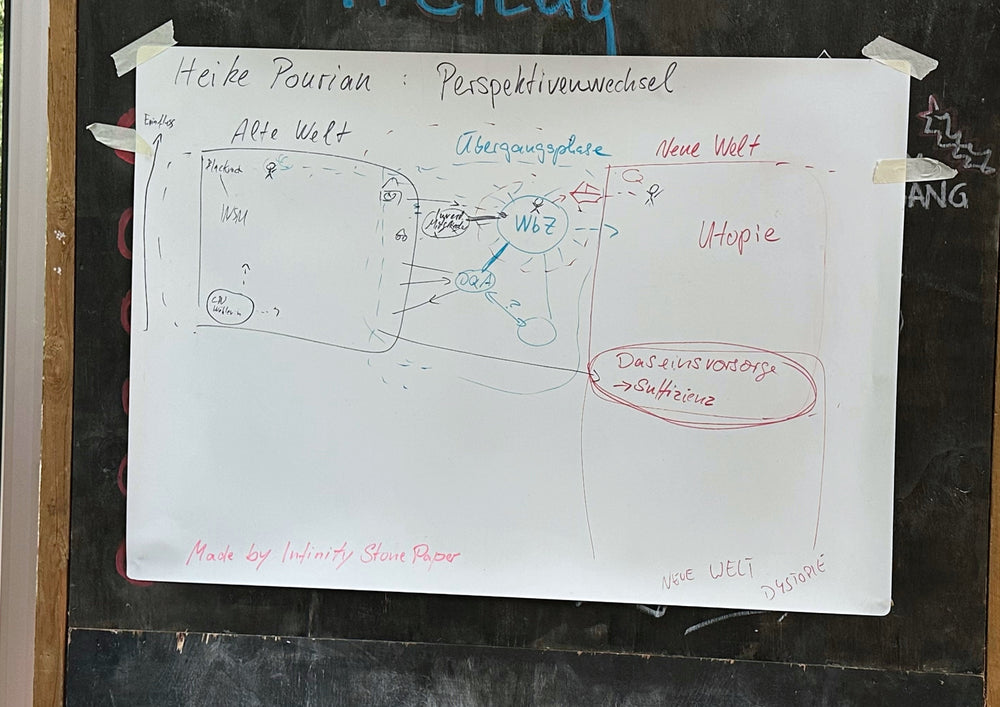
Van Bo Le-Mentzel drew this graphic recording with thermosensitive erasable pens. In theory one wipe would take it away, in practice it has been hanging here unchanged for more than two years. What is meant to stay, stays, until somebody decides otherwise.
Material and handling, 2 of 3
Reset.
The colour sits on top of the smooth surface, and water dissolves it again. How much water and how much rubbing it takes depends on the amount and on the pen: felt pen comes off in the water itself, thermosensitive ink only when you wipe it off over a towel. For stubborn traces, use a vinegar cleaner.
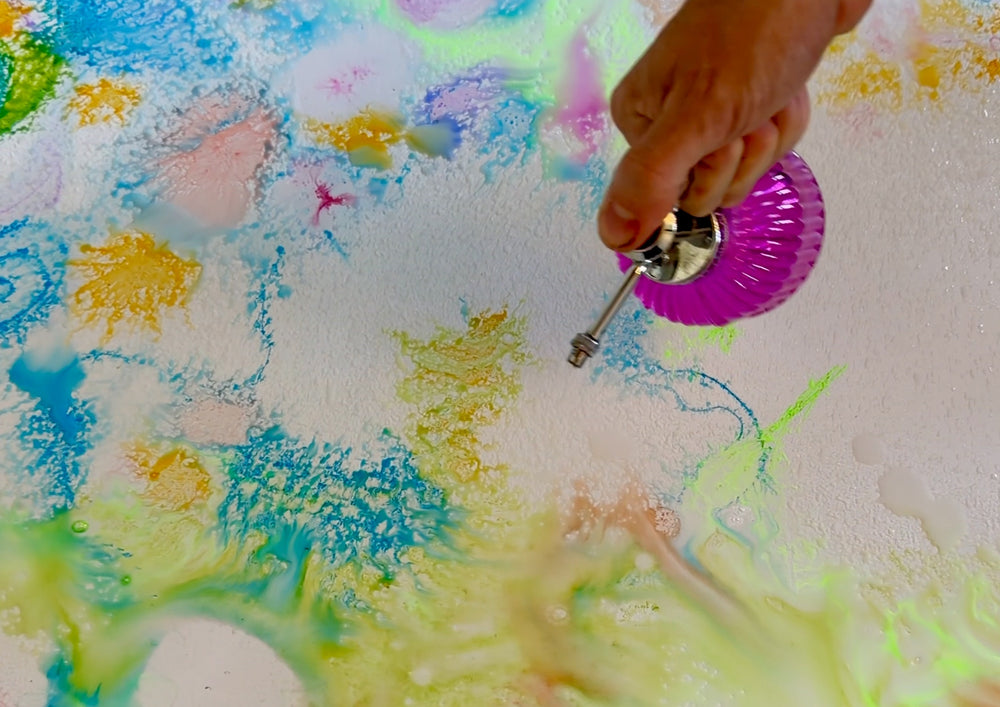
For large Boards a spray bottle: water onto the colour, let it act briefly, wipe off. The colour sits on top, the water dissolves it, a cloth takes it away. Along the way the air in the room stays clear, because only water is involved.
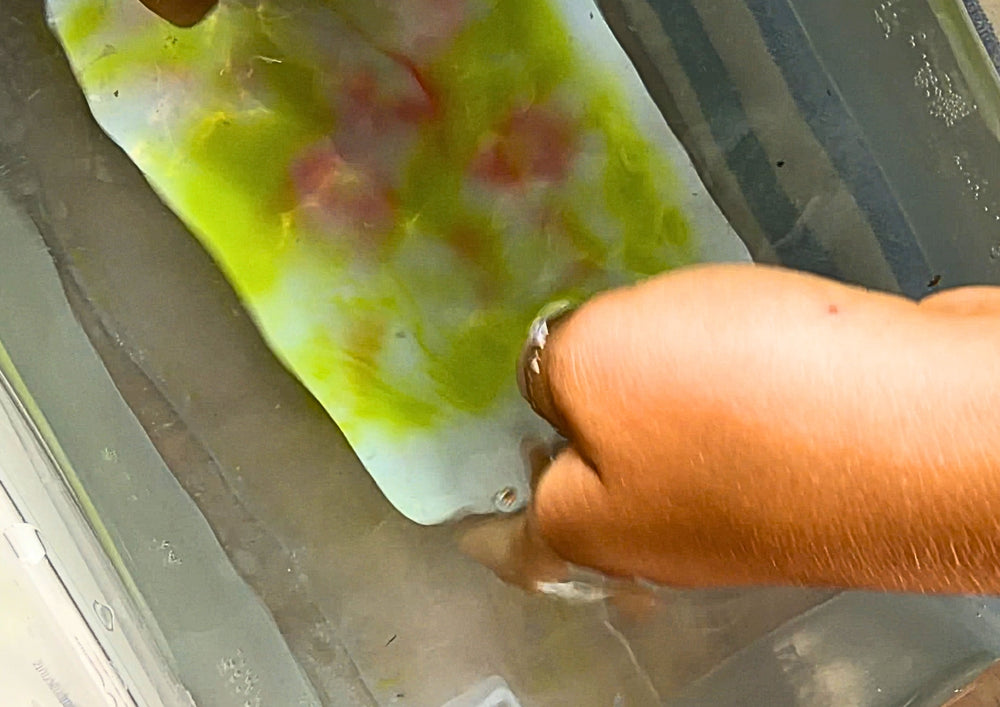
Water into the bowl, colour dissolves, done. The water colours like paint water and goes down the drain, which is why ecological pens are worth it.
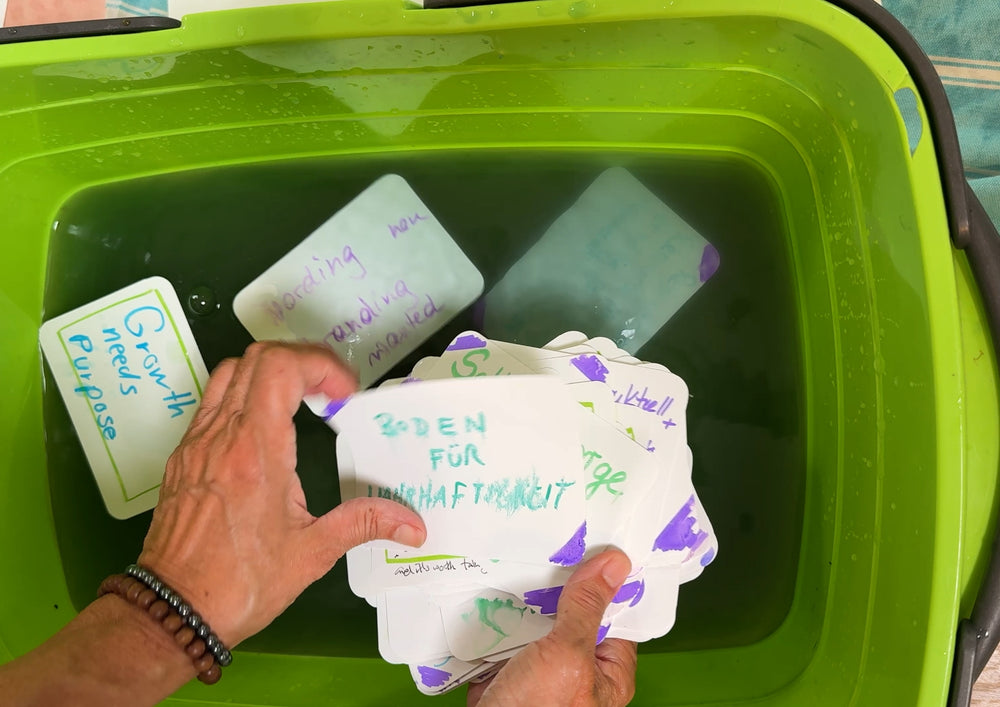
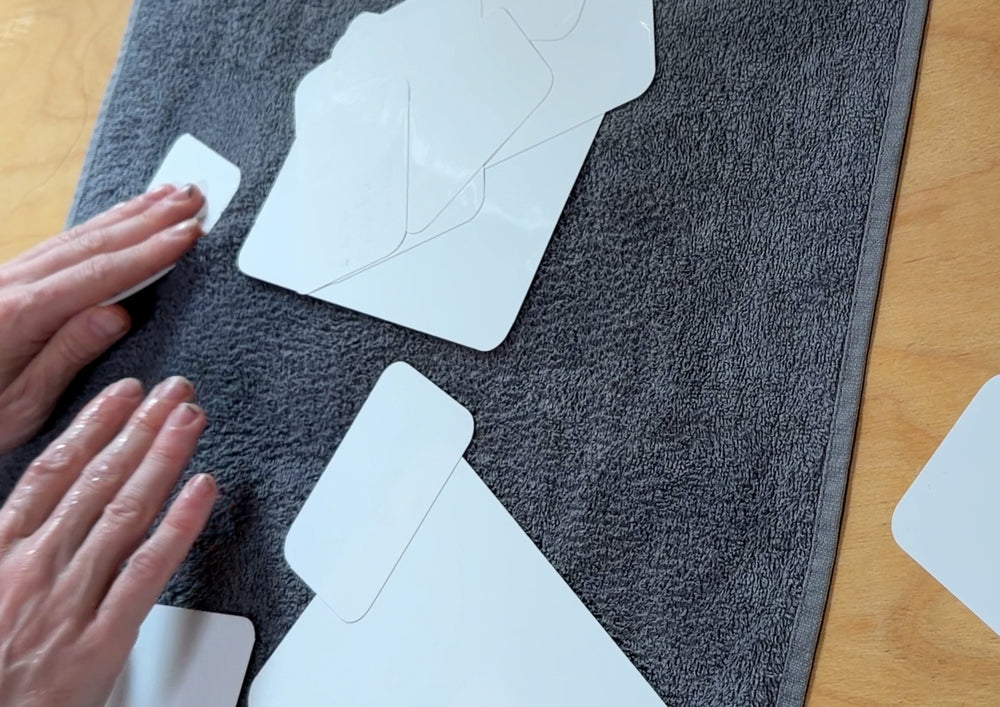
With many cards at once the tub is the quickest way: in they go, the colour dissolves, white cards come out again. Then wipe them over a towel, and thermosensitive ink comes off completely too.
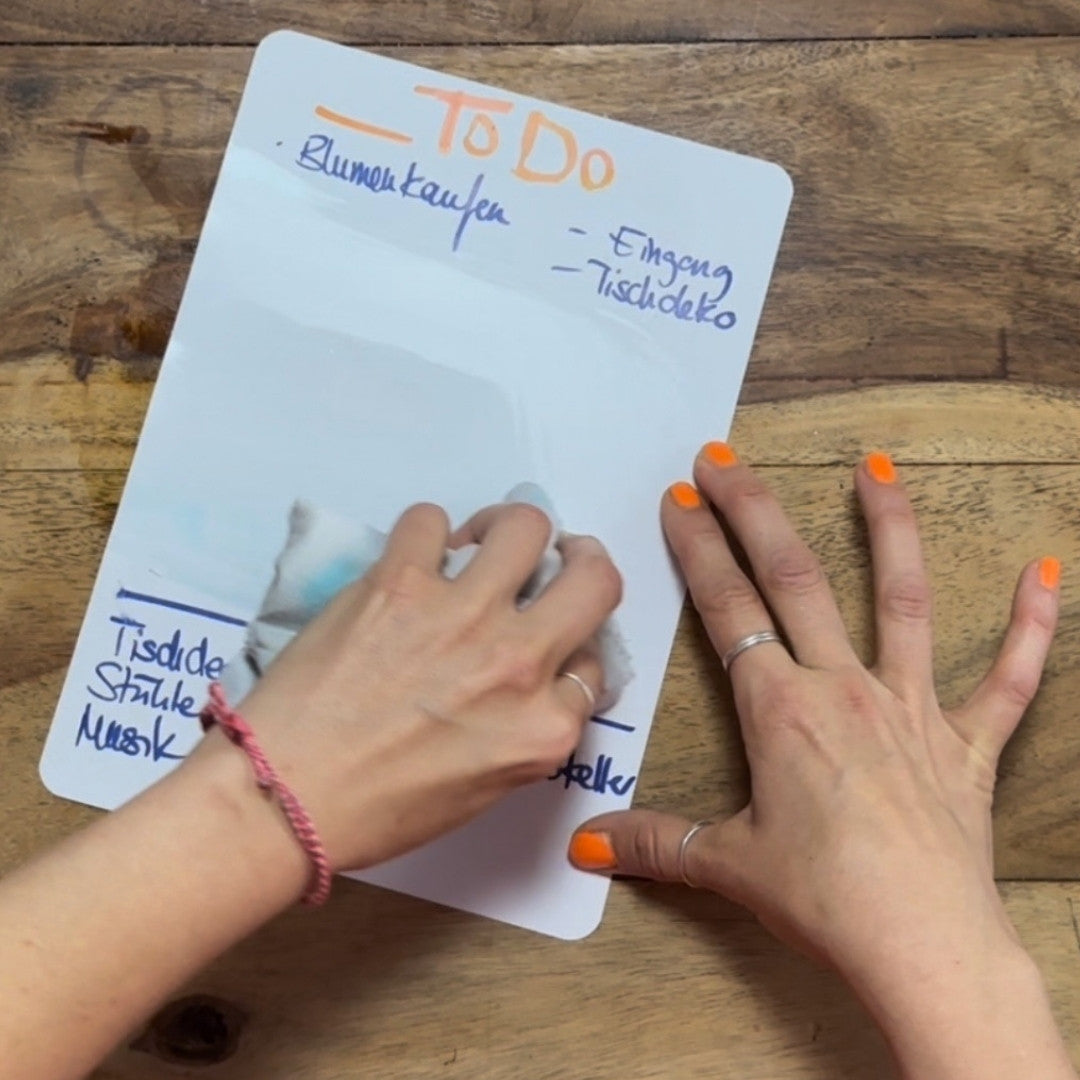
An absorbent towel, wipe both sides, done. If you clean often, you have it in your wrist after a short while, and the short break between two rounds does the group good.
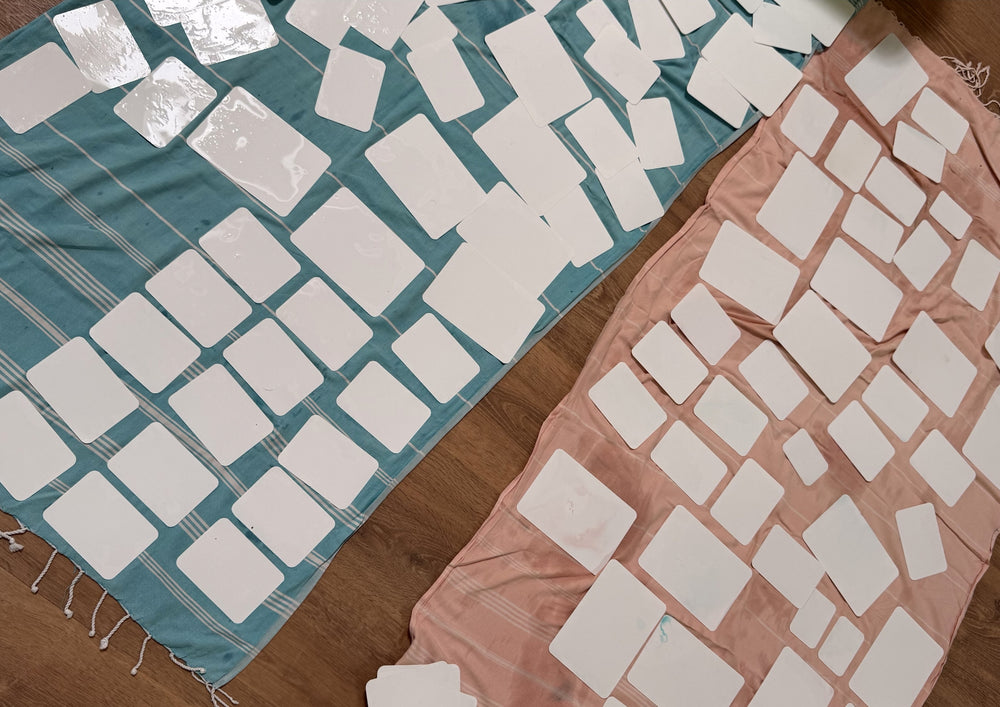
Spread out towels, distribute the cards, air and sun do the rest. Overnight everything is dry.
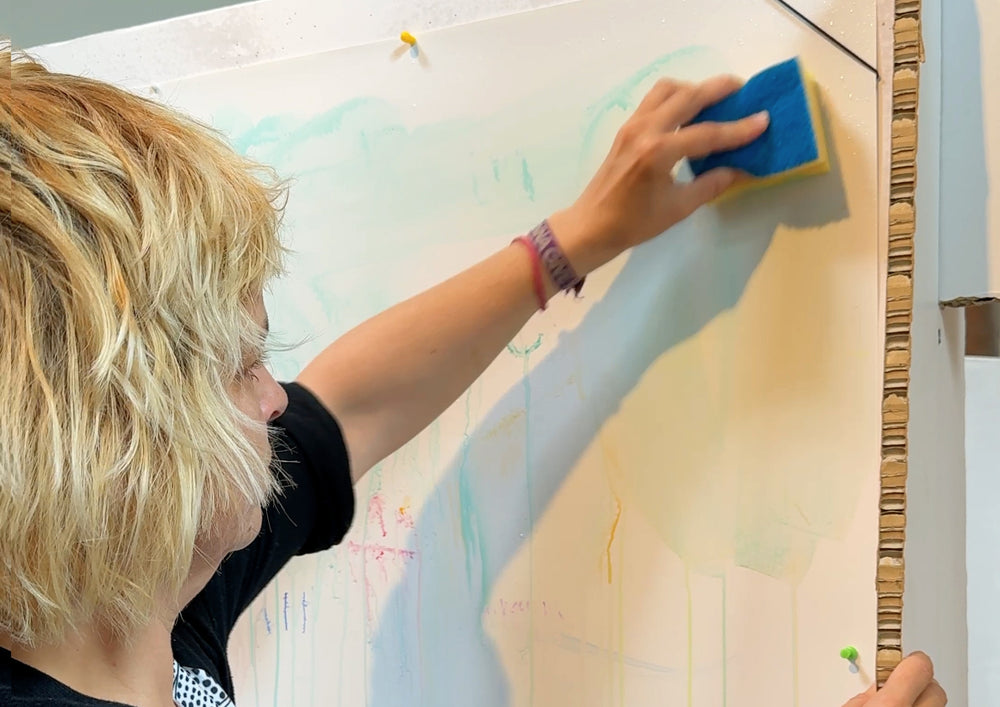
For large surfaces a household sponge is enough, and the rough side helps with the rubbing. Stubborn traces come off with vinegar cleaner, and alcohol and other cleaners have been tested as well, right down to a metal sponge. The surface stays smooth throughout.
Material and handling, 3 of 3
Mounting.
On smooth surfaces stone paper holds by itself with a little water. Everywhere else, clips, magnets and rails that you have in the house anyway will help. And because everything stays removable, everything stays movable.
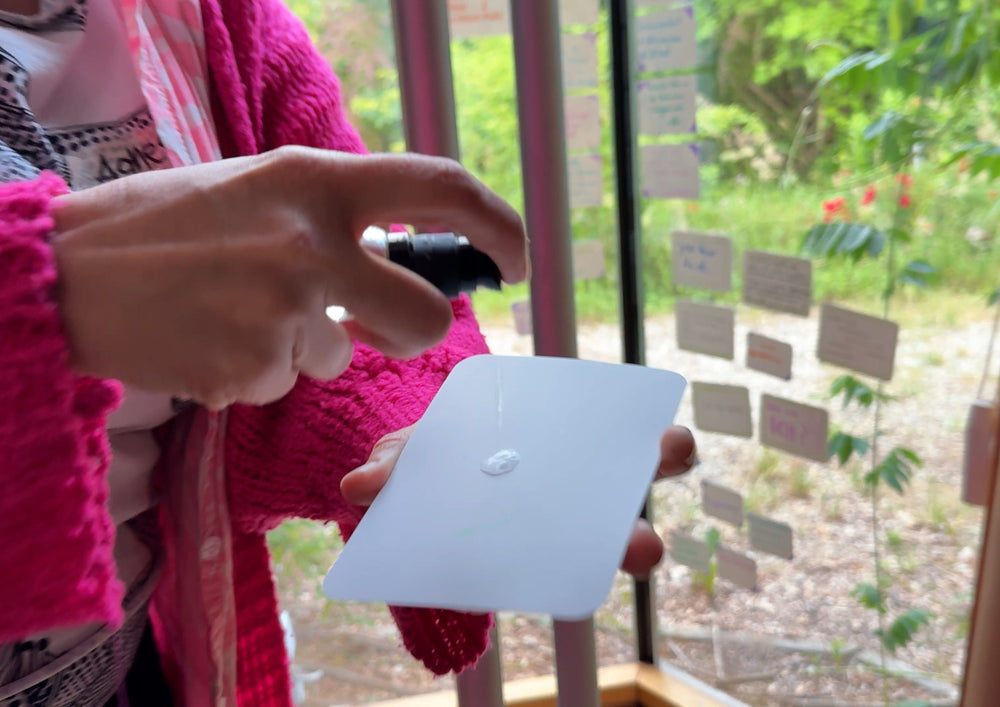
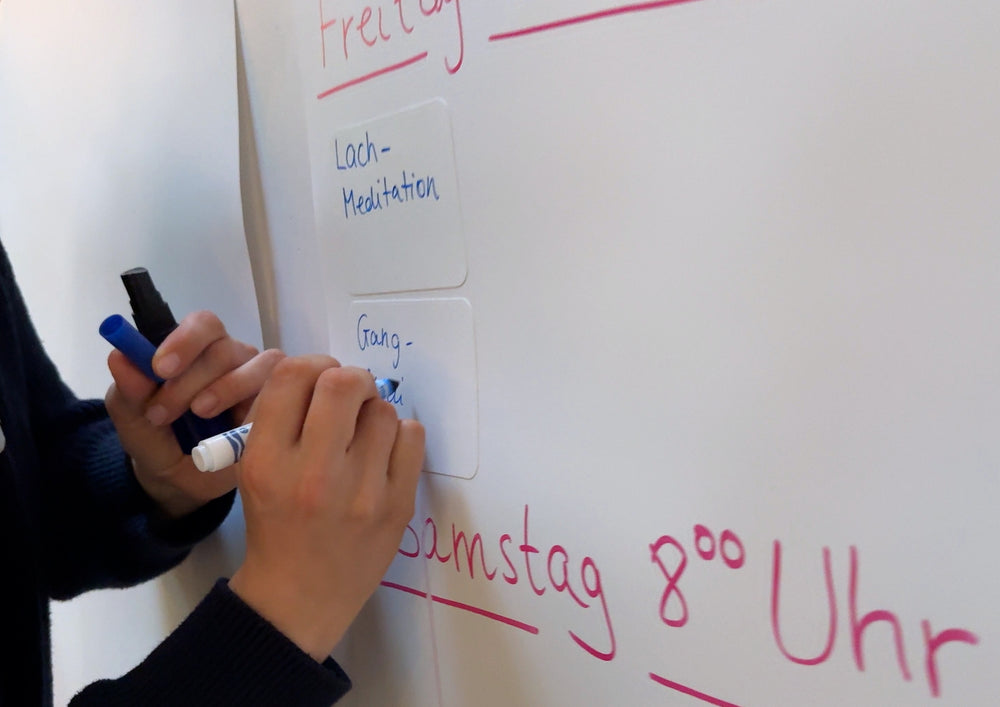
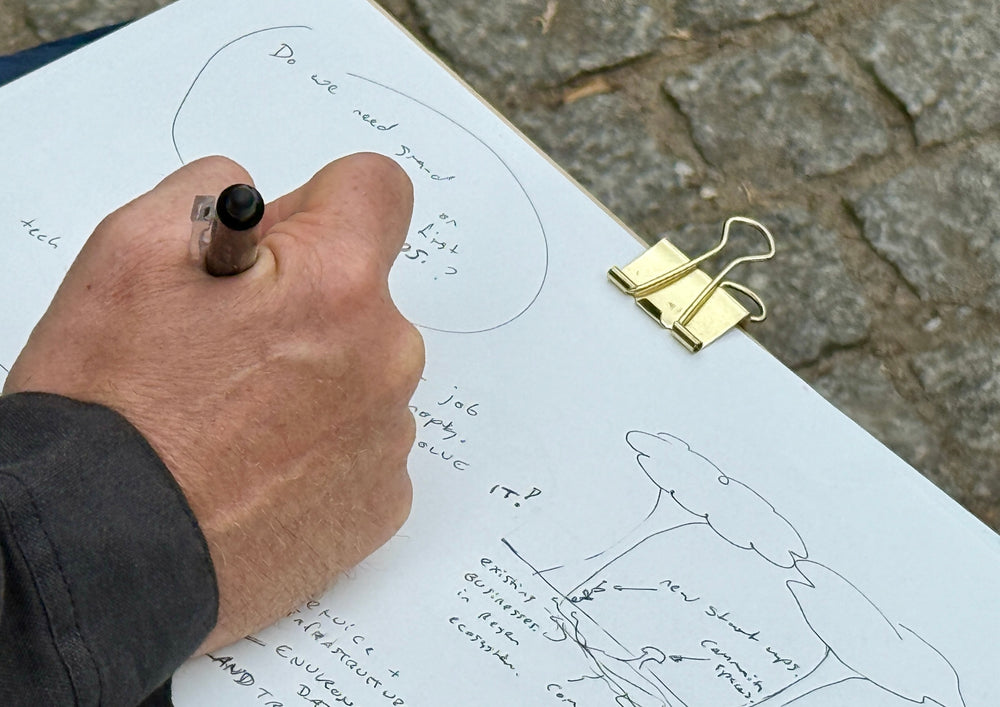
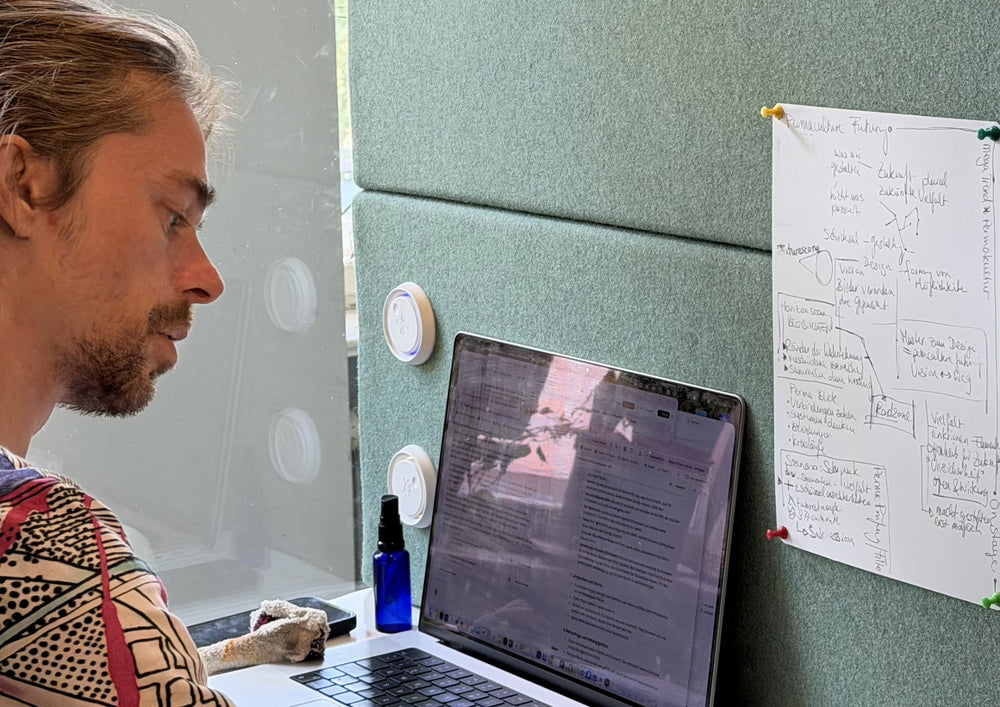
With Notes, Minis and Cards, a little water in the corners, press them on, they hold. An old dropper or perfume bottle is the ideal tool for this, refillable for ever. The rule: more water, firmer hold. If you move cards around often, use less and keep the ideas mobile.
The surface is smooth, so stone paper adheres to stone paper. On a large Board on the wall, Cards, Notes and further Boards hold, one surface becomes the carrier of the next.
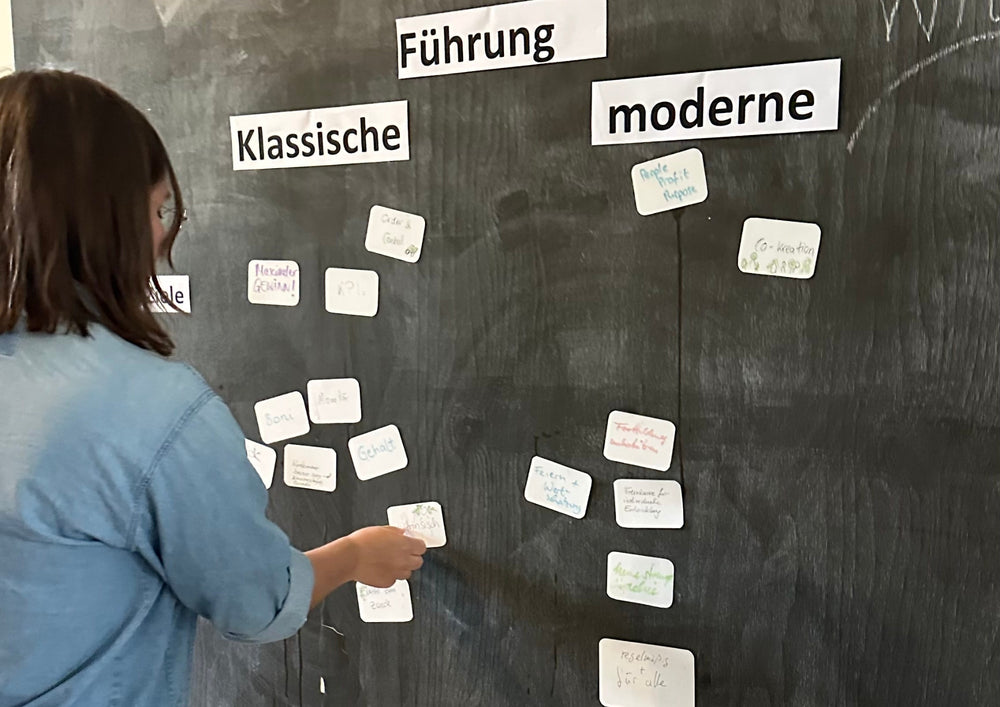
A chalkboard is a smooth surface, and lacquered surfaces are too. What already hangs in the room becomes a working surface directly, and the room stays as it is.
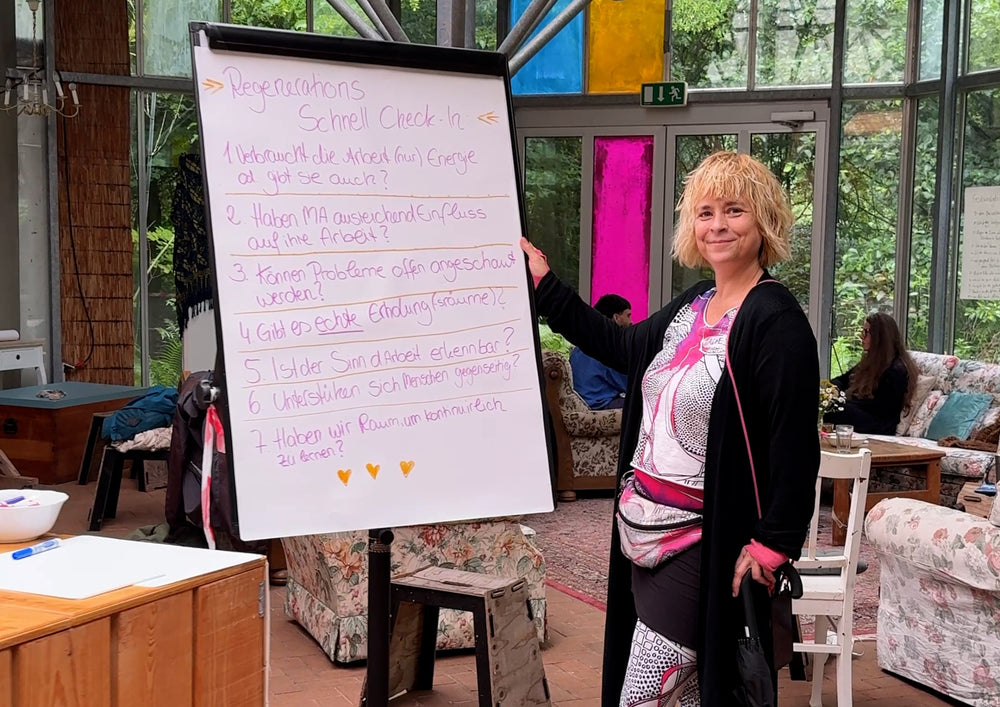
Many holders have a metal board at the back: water on it, stone paper adheres. Alternatively clamp it at the top or fix it with magnets. The familiar stand stays, the sheet on it becomes reusable.
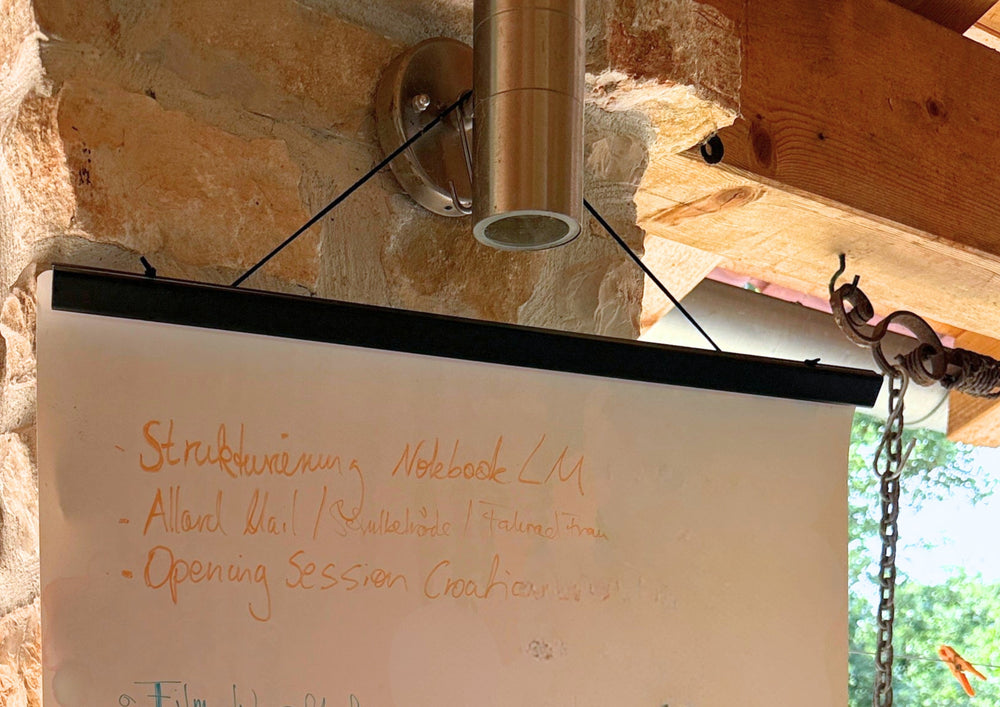
A magnetic rail on a nail or a lamp, and the programme, plan or calendar hangs where it is needed. Rehanging takes seconds, so the rail travels with the group through the room.
An A4 sheet on the clipboard, held by a small clip. Slightly larger clips hold better, and then it also works for excursions and field work.
A large Board on an upturned bench, held at the top with a foldback clip. That is how a learning space is made from what is standing there.
Pins hold as with any paper, and the material withstands the pin. The hole stays, so think about where it may sit.
Quite classic: a strip of masking tape at each corner. For all surfaces on which water alone gives too little hold.
One family, seven formats.
From the XXL Board for a whole wall to the Mini for your pocket, with A3 and A4 in between: the familiar sizes fit into folders, cases and clipboards. Everything follows the same cut, one sheet halved gives the next size.
All measurements in centimetres. Every format is available singly or in a bundle.
What is in it, and why.
Plain words about the plastic
The HDPE holds the limestone together. It is precisely this share that makes the surface waterproof, tear-resistant and wipe-clean: the colour sits on top and comes off again with water.
That is how a single sheet becomes a tool that replaces hundreds of single-use sheets over the years. At the end it is best to let it live on, folded, cut, pasted over. If it does have to go, it belongs in the residual waste: the material can be recovered as a plastic, but in Germany there is as yet no collection route for non-packaging.
Cutting, packaging and shipping are done by the Christophorus Inklusionswerkstätten in Fürstenwalde.
Sustainability
What counts for the environment.
The biggest lever is use: a sheet that stays in service for years replaces hundreds that would otherwise be bought and thrown away. Added to that is a material whose production has been checked by an independent body: by Kiwa, against Cradle to Cradle and against ISO 14001.
In use
One sheet instead of hundreds
Write on it, wipe it with a damp cloth, start again. Every use replaces a single-use sheet that goes unbought. After a year in the classroom that quickly runs into three figures per sheet.
Raw material
Limestone that occurs anyway
Two thirds of the sheet are limestone from quarry residues, finely ground. The remaining third, HDPE, comes partly from recovered material. Both are documented in the Kiwa Covenant.
Production
Dry, without bleach
The web is formed warm from limestone and plastic. Kiwa has checked the water requirement: 0.1 cubic metres per tonne. Chlorine bleach and acids stay out of it, and the limestone is white by nature.
Forest
Without wood fibre
The sheet is made without wood pulp. That is why stone paper falls outside the EU Deforestation Regulation (EUDR), and procurement offices are spared due diligence and proof of origin.
Figures from the Kiwa Covenant K12345 (2015): producing one tonne of stone paper takes 3.1 GJ of energy and 0.1 m³ of water; as typical values for wood pulp paper Kiwa gives 20.4 GJ and 59.3 m³. According to the same assessment, the CO2 footprint from extraction to factory gate is 474 kg per tonne, determined in 2013 on the thinner grade. We send you the covenant, the certificate and the data sheet for procurement and reporting.
What that saves over time.
The trick is simple: you use the same sheet again, for years. Pick a format and slide to set how often you use it.
Wischt nach links für weitere Vergleiche.
Prices including VAT, entry tier of the bundles. Comparison values for single use products (price and weight) are assumptions based on common trade prices and paper weights.
Calculate a quantity→Briefly asked
01How does it become a sheet? +
Mixed, melted and drawn out into a web: a dry process. Process water, chlorine bleach and acids stay out of it, and an independent body has verified this. The limestone is white by nature.
02How heavy is a sheet? +
At 450 g/m² an A4 sheet weighs around 28 grams, a Board of 72 × 51 cm around 165 grams, an XXL Board of 102 × 72 cm around 330 grams. It feels more like thin card than like paper.
03Which pens come off again, which stay? +
Thermosensitive ink and water-based felt pens come off again. Whiteboard markers and permanent pens stay put. For labels that should last a while, that is exactly right.
04Do shadows remain over time? +
After long standing times, pale traces can remain. Cleaning alcohol takes most of them away again. The surface itself stays smooth, even after many rounds.
05What can it take? +
Water in every form: rain on the way, a water bath, a spray bottle. Everyday temperatures too. There are two limits. Heat from around 100 degrees deforms the material, so irons and laminators stay out of it. And permanent sunshine makes it age over time: for days outdoors that is no concern, for permanent signage outdoors something else serves better.
06Can I print on Stonepaper? +
Yes, with UV printing. We print this way ourselves and can recommend it with a clear conscience: the colour sits firmly on the surface, and the printed sheet stays waterproof. It can go completely under water, which makes it particularly useful for weather and for the field. For an office printer, 0.3 millimetres is too thick for most machines, so do talk to us about printed surfaces.
07How long does a sheet last? +
As long as you want to use it. A graphic recording has been hanging on our wall unchanged for more than two years, and surfaces that are written on and wiped every day are still the same ones years later. The only limit is permanent sunshine.
08How does it get into my phone? +
Take a photo, that is it. Devices read handwriting these days.
09What do I do with a sheet that has served its time? +
Best of all, use it for something else. The material can be folded, cut and pasted over, and it works well for origami. If a sheet does have to go, then through the residual waste: as a plastic it can be processed, but in Germany there is as yet no collection route for non-packaging. In the paper collection the plastic share interferes with processing.
10Which documents are available for procurement? +
The material carries Cradle to Cradle Certified, the manufacturer works to ISO 14001, and an independent test examined 161 substances of very high concern and found all of them below the reporting threshold. Because the material is made without wood fibre, it falls outside the EU Deforestation Regulation (EUDR): due diligence and proof of origin therefore do not apply to you. We send you the certificate and the material details on request, for tenders and sustainability reports.
11And if I need a lot of them? +
For teams, schools and larger quantities there are bundles with graduated prices: cheaper from three bundles, cheapest from eight. The price appears straight away.
